
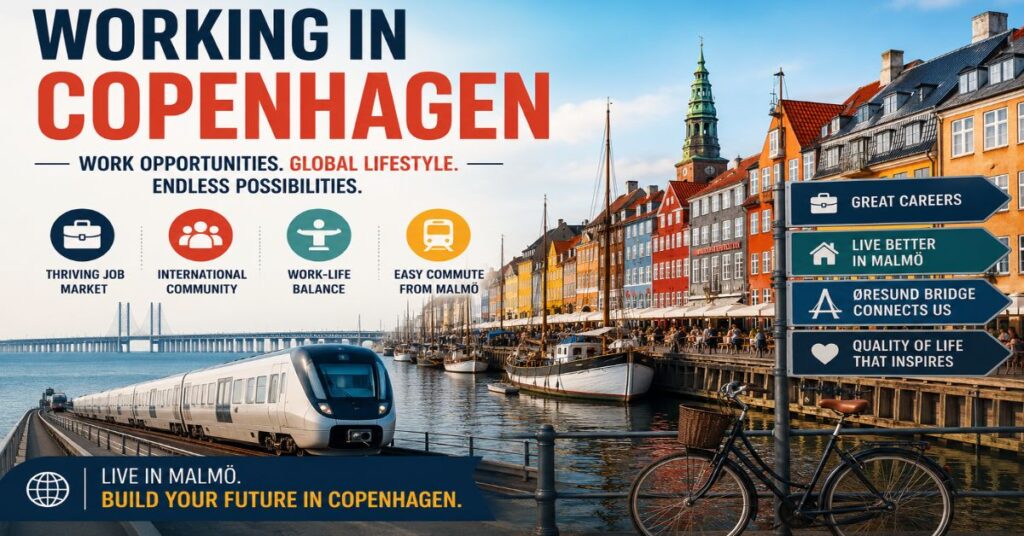
If you’re planning on moving to Copenhagen, you might wonder if it’s possible to live in Malmö and work in Copenhagen. The two cities are separated by the famous Øresund Bridge, a well-known landmark for fans of Nordic Noir.
Malmö, located just 30 kilometres away from Copenhagen, offers a unique opportunity to experience life in one country while working in another. This proximity between Denmark and Sweden allows for an adventurous and flexible lifestyle.
However, while it’s quite possible to live in Malmö and work in Copenhagen, there are important things to consider. Different rules apply depending on your nationality, and you will need to weigh the pros and cons of commuting between the two countries. For example, the practicalities of living in one country and working in another can vary based on your personal situation.
It’s crucial to keep in mind all the practical considerations that come with such an arrangement, from tax regulations to daily commuting.
Ultimately, moving to Copenhagen and living in Malmö can be an attractive option for many, but it requires careful planning and understanding of the rules that come with living and working across borders. Whether you’re looking for a change or are a fan of the cultural mix of Denmark and Sweden, this option offers an exciting lifestyle with its own set of challenges and opportunities.
Does Working in Copenhagen- The Short Answer
Working in Copenhagen offers expats excellent career opportunities in industries like IT, life sciences, and clean tech, along with a strong work-life balance. Many professionals choose to live in nearby Malmö, Sweden, and commute via the Øresund Bridge for a more affordable lifestyle. Copenhagen is highly English-friendly, making it easier for international workers to settle in and grow professionally. With high salaries, efficient public transport, and world-class public services, the city remains one of Europe’s top destinations for expats.
An amazing community is waiting for you!
Copenhagen is a friendly and welcoming city where an amazing community is waiting for you. Many people from different countries live here, so it is easy to meet new friends through events, clubs, and social activities. You can join casual meetups, cultural programs, sports groups, or community gatherings where people talk, share experiences, and enjoy time together. Places like International House Copenhagen also help newcomers feel at home and connect with others in a simple and welcoming way.
In this city, social life is active and open, and you will find many chances to build friendships and networks. Whether you are attending weekly events, joining hobby groups, or just spending time in local cafés and parks, it is easy to meet both locals and internationals. Many communities in Copenhagen are created to help people connect, learn, and feel included, making it a great place to grow personally and professionally while feeling part of a supportive community.
Employment in Copenhagen
If you’re an expat considering working in Copenhagen, you’re in luck! The city is home to thriving sectors like ICT, clean tech, and life sciences, offering plenty of opportunities. To secure a work permit, your boss needs to prove that a suitable Dane couldn’t fill the position.
While tax rates may seem high at first, the benefits far outweigh them, with completely free education and a high-standard healthcare system that makes living and working here even more attractive.
Copenhagen’s flexible working environment and its beneficial location in Northern Europe make it a favorable destination for expats. The Danish capital has grown more popular in recent years, attracting not only expats but also Danes who appreciate the city’s abundance of career sectors and its favorable employment conditions.
With opportunities in key sectors and a great quality of life, it’s easy to see why Copenhagen is an ideal city to work in.
Language, Location,n and Life Balance: An Ideal Destination
Copenhagen is a great business location in Europe because it has strong transport links and easy access to many countries in Northern Europe. The city is part of the Øresund region, which connects Denmark with Sweden through the Øresund Bridge, making travel and commuting simple for workers. Airports, ports, roads, and trains are all well developed, so businesses can easily connect with international markets and nearby cities, helping trade and jobs grow smoothly.
Living and working in Copenhagen is also comfortable because of its good work–life balance and friendly work culture. Many people in Denmark speak English, so it is easy for international workers to settle even without knowing Danish. The job environment is flexible and focused on both productivity and personal time, which helps people enjoy their life while working. This mix of easy communication, strong transport, and balanced lifestyle makes Copenhagen an ideal place for professionals from around the world.
The Job Market: Where to Look
The job market in Copenhagen offers many opportunities for international workers, especially in growing fields like life sciences, information and communication technology (ICT), clean energy, and creative industries. These sectors are strong in Denmark because the country has advanced research, global companies, and a focus on innovation, which creates many skilled job openings for both locals and expats.
If you are looking for work, it is best to focus on these main industries first, as they often hire English-speaking professionals and offer roles in engineering, IT, science, and design. Companies in these fields value skilled workers, and many positions are open to international candidates, making Copenhagen a good place to start or grow your career.
Life Science and Clean Tech
Copenhagen is a major hub for life science and clean-tech industries, attracting both locals and expats to its strongest life science locations. One of the key areas, Medicon Valley, is a bi-national center for life science, spanning Denmark and Sweden’s Skåne Region, where international investors and leading companies are setting up operations.
The collaboration between hospitals, universities, and specialized service providers creates a high-class working environment, with cutting-edge research in areas like neuroscience, cancer, metabolic diseases, allergy, and autoimmune diseases.
In addition to life sciences, Copenhagen is becoming a global leader in clean-tech. Many clean-tech companies are choosing to establish branch offices in the city, thanks to its commitment to sustainability.
Copenhagen aims to become the first CO2-neutral capital by 2025, positioning itself as a world-class city for research and development in sustainability.
The synergy between the life science sector and clean-tech makes Copenhagen an ideal city for professionals looking to make a meaningful impact in Europe. Whether you’re an expat or a local, working in these dynamic sectors offers plenty of opportunities for growth and innovation.
The ICT Sector
Copenhagen is a leader in information and communication technologies (ICT) and offers many opportunities for expats. The city is home to a highly skilled workforce that makes its ICT industry one of the most innovative in Europe.
Many international companies are based in Copenhagen, and some may offer transfer opportunities for employees, including positions in their Copenhagen-based affiliates. Big names like Microsoft, IBM, and Cisco have offices here, providing jobs for over 100,000 people in the Greater Copenhagen and Øresund region.
The city is also known for its IT cluster in the Copenhagen area, which works closely with Skåne and the Øresund IT Academy. With such a strong presence of ICT companies, Copenhagen continues to attract professionals looking to advance their careers in the ICT sector.
Whether you’re an expert or new to the field, working in Copenhagen offers a thriving environment for international companies to grow.
Creative and Entertainment Industry
Copenhagen, located in the Øresund Region, has a long history in movie making, with famous directors like Carl Theodor Dreyer, Bille August, and Lars von Trier helping to make the city and surrounding region well-known in the film industry. Today, creative industries contribute around 7% of Danish employment and revenue, making it an attractive field for expats looking to work in Copenhagen. Many production companies are based here, offering great opportunities for professionals in this sector.
Additionally, the entertainment industry is thriving in Copenhagen, with the video game industry growing rapidly. More and more software developers are settling in the city, bringing innovations and high technology to the region.
This combination of creativity, technology, and innovation makes working in Copenhagen an exciting and attractive proposition for those in the creative and entertainment industry.
Finding Work in the City of Spires
Job Centers and Databases: How to Find Work
Finding a job in Copenhagen can be a challenging process, especially for expats. One of the most convenient ways to secure work is through intra-company transfers, which allow employees to move abroad. For those who are searching on their own, it’s important to spend some time familiarizing yourself with the Danish language, even though many people in Copenhagen speak English.
A basic command of Danish can be helpful during your job search.
If you’re in Denmark for a while and need to look for work again, visiting a job center is a good step. It’s also where you would need to register if you become unemployed. Additionally, activating your expat network can be very useful, as not all positions are openly advertised.
You can also browse online job databases like Jobindex or Workindenmark, check newspaper classifieds, and look at magazine ads. Private employment agencies may also refer you to the right kind of job for a price.
Getting a Work Permit
If you’re not from an EA/EEU country, a Nordic country like Finland, Norway, or Sweden, or Switzerland, you will need a work permit to take up full-time employment in Copenhagen. Before applying for a work permit, your prospective Danish employer must prove that no qualified Danish applicants were available for the job.
There are various work permit schemes designed to make the process easier for expats, such as the Corporate Scheme for transfers to a Danish branch and the Pay Limit Scheme, which applies if your yearly income exceeds 400,000 DKK (about 60,000 USD).
The Green Card Scheme allows you to travel to Denmark to search for a job and then take up employment. The Positive List includes occupations that have a labor shortage, and getting a job on this list helps you apply directly for a work permit. Researchers also have easier access to the Danish labor market.
For those from non-EU/EEA countries, these schemes apply, while EU/EEA countries and Swiss nationals do not need a work permit. However, they must obtain a residence permit within three months of moving to Copenhagen.
Efficient and Productive: Business in the Capital
The Central Business District
Copenhagen’s central business district, also known as Ørestad City, is one of the newest and most dynamic business areas in Northern Europe. Located in Ørestad on the island of Amager, it offers excellent infrastructure and connections to Copenhagen’s public transportation system. The ØresundBridgee, train station Ørestad, and Copenhagen Airport are easily accessible, making it an ideal location for international companies.
Businesses like DELL, UCB Pharma Nordics, Nikon, Accenture, and Novo Nordisk Scandinavia have offices here, and the area is constantly being expanded and developed.
In addition to being a business hub, Ørestad also houses Universitetskvarteret, or the University Quarter, which includes various educational institutions. This provides excellent research opportunities and makes the area an attractive place for professionals in both business and academia.
As Ørestad continues to grow, it aims to become the leading business hub in Northern Europe, drawing more international companies to set up offices and further enhancing the city’s reputation.
Secure and Protect: Denmark’s Flexicurity Model
Denmark’s flexicurity model combines job flexibility with strong social security, especially in cities like Copenhagen. This means companies can hire and change staff easily, but workers are still protected through support systems like unemployment benefits, pensions, and training programs.
Because of this system, people can switch jobs without losing important rights such as pension savings, which gives workers more freedom and security at the same time.
At the same time, Copenhagen offers a healthy work–life balance, with a typical 37-hour work week and a culture that values personal time outside work. The workplace is efficient but not overly stressful, and employees are encouraged to leave work on time and enjoy life.
Even though the job market is flexible, strong social support and active job programs help people stay stable during changes, making Denmark a safe and balanced place to work and live.
High Taxes for Excellent Public Services
In Denmark, including Copenhagen, taxes are high, and expats may receive tax letters from the Danish Tax Agency (SKAT) during the year. Income tax can sometimes be more than 50%, and there is also VAT (called “moms”) on most goods and services, usually around 25%.
At first, this may feel expensive, but taxes are clearly included in prices, so you do not need to calculate extra costs when shopping.
Even though taxes are high, they help fund strong public services that everyone can use. This includes free healthcare, education, and social support systems that make life easier and safer for residents.
Because of this system, people in Denmark enjoy good public services and a high quality of life, where tax money is returned through benefits that support the whole society
How Does Tax Work if You Live in Malmö but Work in Copenhagen?
If you live in Malmö but work in Copenhagen, your tax situation depends on cross-border commuter rules between Sweden and Denmark. In most cases, you are taxed in the country where you physically work, but special agreements (like the Øresund rules) can decide whether Denmark or Sweden has the main right to tax your salary.
If you meet certain conditions, such as spending most of your working time in Denmark, you may be treated as a cross-border worker and avoid double taxation, while still reporting income in both countries if needed.
You may also qualify for specific deductions, especially for commuting costs and work-related expenses, depending on how your tax status is set. These rules are not automatic, so you must register with the tax authorities in both countries and confirm your exact situation with SKAT and Swedish tax offices.
Because the rules can change based on where you work each day, it is important to check your personal case before you start working to avoid mistakes or overpaying tax.
Can I Legally Live in Malmö but Work in Copenhagen?
If you’re wondering whether you can legally live in Malmö but work in Copenhagen, the answer depends on your nationality. As a Nordic citizen, such as a Swede, you can easily commute to Denmark and work in Copenhagen due to the Nordic Passport Union, which allows free movement and work between Nordic countries.
If you hold an EU passport or an EEA passport, you can also live in Sweden and work in Denmark without needing a residence permit, though you will need to register with the local authorities.
For Swiss citizens, it’s a bit more complicated. While Switzerland is in the Schengen Area and offers freedom of movement agreements, you will need a residence certificate to live in Denmark for more than 90 days. However, if you are a non-EU citizen, including Brits post-2021, you will need a work permit to live and work in both countries.
If you are offered a job with a high salary, you may apply for the Pay Limit Scheme, which requires a minimum yearly salary of 514,000 DKK (around $71,450). Alternatively, if your job is on the Positive List for Skilled Work, it can help you get a work permit more easily.
The Pros of Living in Malmö and Working in Copenhagen
Frequent Train Services
One of the pros of living in Malmö and working in Copenhagen is the convenience of frequent train services. On weekdays, trains between the two cities typically run every 20 minutes, making it easy to manage your daily commute. You won’t have to wait long for a train, so your daily journey is smooth and efficient.
If you’re unsure about this commute, it’s a good idea to visit Copenhagen and Malmö over the same weekend and try staying in Malmö while commuting to Copenhagen to get a feel of it. You can even plan a three-day itinerary to help with your planning.
The Opportunity to Learn Two Foreign Languages
Living in Copenhagen gives you a good chance to learn both Danish and Swedish in a simple way. These two languages are closely related, so if you learn one, it becomes easier to understand the other. Many expats start by learning Danish because it is the main language in Denmark, and they practice it in daily life through work, shopping, and social activities. Language schools and community programs also help newcomers learn step by step in a structured way.
Even though many people in Copenhagen speak English, learning Danish helps you connect better with local culture and people. At first, it may feel challenging, but regular practice in real situations makes it easier over time. Knowing both Danish and some Swedish can also make travel and communication in the region more useful, helping you feel more confident and integrated in everyday life.
FAQ
Is Copenhagen a good place to work?
Copenhagen, the capital city of Denmark, has been ranked as the best city for workers globally, according to a recent study by Office Freedom. With an impressive score of 85.4 out of 100, Copenhagen outperformed other cities in important areas like work-life balance, job satisfaction, and employee-friendly conditions. This makes Copenhagen an excellent place to work, offering a great environment for both personal and professional growth.
Can I work in Copenhagen if I only speak English?
Yes, you can absolutely find a job in Copenhagen even if you only speak English. Many fields, such as IT, engineering, and academia, often require English as the primary working language. Additionally, many multinational companies in Copenhagen operate in English, so not speaking Danish is not a barrier in these industries. Finding a job without Danish is certainly possible, especially in these sectors where English is widely used.
Can Americans work in Copenhagen?
U.S. citizens who plan to visit Denmark for reasons other than tourism or wish to remain in Denmark for more than three months must obtain a work permit and/or residence permit before their arrival. Applications for these permits need to be submitted through a Danish Embassy or Consulate. It’s important to plan to ensure all necessary paperwork is in order before moving to Copenhagen.
What is the 11-hour rule in Denmark?
The 11-hour rule in Denmark is a legal requirement that ensures all employees get a minimum of 11 consecutive hours of rest within 24 hours. This rule is part of the EU Working Time Directive and is designed to give workers adequate time to recover between workdays. It also includes other rights like additional rest periods and sets limits on the total working hours for employees.